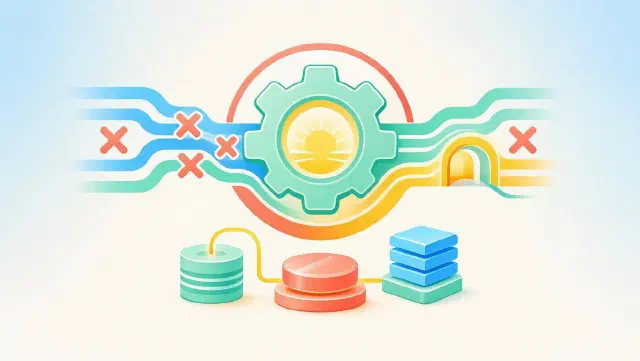

Back in June, this blog flagged a real tension: Claude Fable 5’s Mythos-class safety architecture came with a mandatory 30-day data retention requirement, and that requirement was serious enough to break GitHub Copilot’s Zero Data Retention policy outright. Enterprise and Business admins had to explicitly opt in just to turn Fable 5 on. The tradeoff was blunt — get Anthropic’s most capable model, or keep your ZDR compliance posture, not both.
Enterprise Frontier Safeguards got a single bullet point when it surfaced alongside the Fable 5.1/Mythos 5.1 launch on September 1 — “zero-data-retention, customer-infra, rolling out fall 2026,” easy to skim past in a roundup full of pricing and benchmark news. It deserves more than a bullet. Read against Anthropic’s own dedicated announcement, EFS is the actual resolution to the June problem, worked out with the same class of customer who complained about it.
On September 1, per Anthropic’s own announcement, that tradeoff went away. Enterprise Frontier Safeguards (EFS) is Anthropic’s answer to a question that’s been sitting unresolved for a quarter: how do you keep detecting sophisticated cross-session misuse — the entire reason retention exists — without asking a bank, hospital, or telecom to hand a vendor a copy of its logs?
What actually changes#
EFS has three opt-in pieces, and none of them involve Anthropic holding your data:
- Customer-owned storage. Activity data lands in the customer’s own AWS S3, Azure Blob Storage, or Google Cloud Storage account — not Anthropic’s infrastructure.
- Customer-managed encryption keys. The customer controls the keys and the access policy, full stop.
- Fully automated review. Pattern-based monitoring scans for misuse signals — cyberattack tooling, credential theft, offensive-capability development — and routes flags directly to the customer’s own security team. No Anthropic human ever looks at the data.
Anthropic is explicit that this isn’t a downgrade dressed up as a feature: “not motivated by a desire to train on enterprise data” was the framing behind the original retention requirement, and EFS doesn’t change model behavior, pricing, or rate limits — it just moves custody. Support spans Claude Code, Claude Enterprise, the Claude Platform, Bedrock, Google Agent Platform, and Microsoft Foundry, and Anthropic isn’t charging for it — customers just pay their own cloud provider for storage and egress, the way they’d pay for any bucket they already own.
Anthropic actually asked the CISOs who complained#
The rollout involved more than 100 customers across financial services, healthcare, manufacturing, telecom, law, retail, and the public sector — including direct work with the Analysis and Resilience Center for Systemic Risk (ARC), whose membership reads like a systemically-important-bank security org chart: Goldman Sachs, Morgan Stanley, Citi, Bank of America, Wells Fargo. Wells Fargo’s own CISO, Munish Kumar Sharma, put it about as plainly as a customer quote ever does: “Enterprise Frontier Safeguards gives us exactly what we asked for: our logs stay in a Wells-managed environment under Wells-managed keys.” Snowflake’s Mayank Upadhyay and Cognition’s Scott Wu are quoted making the same point from the vendor side — data stays put, frontier models come in anyway.
That’s a genuinely different posture than “here’s a policy, take it or leave it.” Anthropic built the mandatory-retention requirement in the first place because Mythos-class models need cross-session signal to catch sophisticated misuse that a single-session view would miss — that’s a real security tradeoff, not an arbitrary one. What EFS demonstrates is that the tradeoff was solvable with better plumbing, not with weaker detection. The “no Anthropic human review required” clause matters here too: it’s not just encryption theater, it’s a structural removal of the vendor from the loop entirely, which is exactly what a regulated enterprise’s own compliance and legal teams need to sign off without renegotiating a contract every time a new model ships.
The rollout isn’t instant, and that’s fine#
EFS ships in phases starting later this fall, with broad availability targeted for later in the season — not immediately. Customers who already qualify for zero data retention keep that status until EFS is available to them, so nobody gets stuck in a worse position while this rolls out. Given how narrow and specific the original problem was — a hard requirement colliding with hard compliance obligations at exactly the enterprises Anthropic most wants running Claude Code in production — a few months of phased rollout is a reasonable price for actually solving it instead of shipping a half-measure.
Why this is the right kind of enterprise feature#
Compare this to how the industry usually handles the security-versus-privacy tension: either the vendor holds the data and asks you to trust its access controls, or you get a stripped-down, ZDR-compliant tier that trades away capability for compliance. EFS refuses that binary. The data never leaves the customer’s cloud account, the customer holds the keys, and the misuse-detection logic still runs — automatically, without a human at Anthropic ever seeing the raw logs. For a blog that’s spent all year arguing Claude Code is the more serious platform for teams that actually ship production software, this is the unglamorous but load-bearing kind of feature that argument depends on: not a benchmark win, but proof that “frontier capability” and “an enterprise security team will actually approve this” don’t have to be in tension. GitHub Copilot’s off-by-default Fable 5 toggle from June was a symptom. EFS is Anthropic actually treating the disease.
Sources: Developing Enterprise Frontier Safeguards with our customers — Anthropic; Anthropic Announces Enterprise Frontier Safeguards, Customer-Held Data — Unite.AI; Anthropic replaces data retention policy with Enterprise Frontier Safeguards — Quartz; Anthropic Introduces Enterprise Frontier Safeguards (EFS) — MarkTechPost; this blog’s own prior coverage of Claude Fable 5’s GitHub Copilot enterprise data-retention bind.